The Real Bible: Neuroanatomy and Physics
The Bible read as a coded manual for the human nervous system: temple as skull, pineal as the single eye, biophotons as 'God is light,' the meditative arc.
“The kingdom of God is within you.” — Luke 17:21 (KJV)
The claim that organizes everything below is simple enough to state in one sentence. The Bible is not a history book. It is a coded description of what happens inside the human skull during meditation, dramatized as the lives of men so the uninitiated would read it as story and the initiated would recognize it as a manual.
If that is true, almost everything most people have been told about scripture is the wrong kind of true — historically literal where it should be physiologically literal, externally located where it should be internally located, two thousand years ago where it should be right now, between your ears.
This post is the crux of that claim, in five moves. The metaphysical thesis. The brain as a theological structure. Donahue’s bridge from scripture to neuroanatomy. The biophoton physics that grounds the God is light claim in measurable science. And the twelve-station arc that ties them together as a single operation.
1. Reality Is a Projection of Consciousness
The first move is to take seriously what various schools of thought have said for three thousand years.
Reality is not an objective external thing that happens to you. Reality is a projection of your internal state of consciousness. The separation between you and the world is a useful navigational illusion, but an illusion. Change the inner state, and the outer world reorganizes to match. Not metaphorically. Mechanically.
Christianity calls this faith.
The operative formula is also simple:
God Is Consciousness
The traditions don’t describe God as an entity outside creation. They describe consciousness itself — the infinite aware field in which all experience arises, exists, and dissolves. “I AM THAT I AM” (Exodus 3:14) defines God not as a being among beings but as pure being itself. Hinduism’s Tat Tvam Asi — “thou art That” — says the same. Buddhism describes mind as the ground state, all phenomena arising from a luminous void that is aware. Kabbalah’s Ein Sof is the unknowable infinite from which everything emanates. Sufism preserves the Hadith Qudsi: “I was a hidden treasure, and I loved to be known, so I created the world.” Christopher Langan’s CTMU describes reality as a self-configuring, self-processing language — a universe that thinks itself into existence.
They all sound eerily similar.
The Self Is God Pretending to Be Human
If consciousness is what is, then the only thing you can be is consciousness wearing the costume of a particular human life. “My name is Jeff”. The Hindu concept of Lila — divine play — frames existence as the game God plays with itself, pretending to be finite, forgetting it is pretending, and rediscovering itself.
Watts: “God likes to play hide-and-seek, but because there is nothing outside of God, he has no one but himself to play with. But he gets over this difficulty by pretending that he is not himself.” Neville: “God sleeps in man and awakens as man.” Your imagination is God’s creative power operating through you. The same power that said “Let there be light” is the power you use when you visualize, assume, and feel.
The practical consequence is the part most readers skip past too fast. If you are God in disguise, then nothing external has power over you that you have not given it. Fear, neediness, desperation — these are the forgetting. Belief, faith, detachment — these are the remembering. Every spiritual practice, stripped to its core, is a technology for remembering what you already are.
This is the metaphysics. It is the premise of everything. Everything below assumes it.
2. The Brain as Trinity
Take the metaphysics down a level and the same structure shows up in neuroanatomy. The human brain isn’t just an organ. It’s a theological map whose architecture mirrors the spiritual archetypes that appear across every major tradition.
| Brain Structure | Spiritual Archetype | Function |
|---|---|---|
| Subconscious Mind | The Virgin Mary | Receives the seed of intention, gestates it into reality |
| Right Hemisphere | Christ / The Son | Holistic awareness, presence, unity, creative imagination |
| Left Hemisphere | Satan / The Adversary | Analytical separation, ego construction, judgment, doubt |
The Subconscious as the Virgin Mary
The subconscious is the most powerful creative engine you possess. It operates exactly like the Virgin Mary in the theological narrative: it receives a seed and gives birth without question.
Neville’s framing: “The conscious is male; the subconscious is female. The conscious generates ideas and impresses these ideas on the subconscious; the subconscious receives ideas and gives form and expression to them.” The conscious mind plants a seed — an assumption, a belief, a vivid imaginal act. The subconscious accepts the impression in total surrender and gestates it into physical reality. The birth shows up as synchronicities, opportunities, shifted circumstances. Mary’s response to the angel is the operating principle: “Be it unto me according to thy word” (Luke 1:38). No negotiation. No “but how?” No timeline demands.
The danger is that the subconscious is always pregnant. If you don’t consciously impregnate it with intention, it gets impregnated by whatever inputs you expose it to — news cycles, social media, other people’s fears, doom scrolling. The subconscious doesn’t distinguish between what you want and what you dwell on. Neville: “Your subconscious impressions determine the conditions of your world. The subconscious is not selective; it is impersonal and no respecter of persons.”
Practical implications: guard your inputs. The hypnagogic state at the border of sleep is when the subconscious is most receptive — plant seeds there. The subconscious responds to feeling, not words; an affirmation without emotional conviction is a barren seed. How and when are not your department. The Virgin Mary did not ask for a project timeline.
Right Hemisphere: The Christ Mind
McGilchrist’s The Master and His Emissary (2009) demonstrates that the right hemisphere is the Master — broader, more contextual, more reality-connected. The left is the Emissary, useful for specific analytical tasks but catastrophic when it usurps the master’s role.
The right hemisphere processes reality holistically. It doesn’t separate, label, or judge. It experiences the present moment as an undivided whole — pure awareness without narration. This is the Christ consciousness. Unity over separation. Presence over linear time. “I and my Father are one” (John 10:30). “Take therefore no thought for the morrow” (Matthew 6:34). The seat of creative visualization, intuition, direct knowing, empathy, the still small voice.
The neurological proof came in 1996, when Harvard neuroanatomist Jill Bolte Taylor suffered a hemorrhagic stroke in her left hemisphere. As her left brain shut down over four hours, she experienced pure right-hemisphere consciousness. She described overwhelming peace, the dissolution of the boundary between self and world, a sense of being one with all energy and matter, and a state she explicitly called Nirvana. Later: “I can step into the consciousness of my right hemisphere where we are — I am — the life force power of the universe, and the life force power of the 50 trillion beautiful molecular geniuses that make up my form. At one with all that is.”
This is not mystical speculation. This is a trained neuroscientist reporting direct experience of what happens when the left hemisphere’s chatter stops. The book version is My Stroke of Insight (2008).
To operate from the Christ mind: quiet the left hemisphere’s narration. Enter stillness. Visualize. Feel the wish fulfilled. Be present. This is prayer. This is meditation. This is the kingdom of heaven, and as Luke 17:21 says, it is within you.
Left Hemisphere: The Adversary
Satan in Hebrew (שָׂטָן) means the adversary, the accuser, the opposer. Not a red demon with a pitchfork. A function — the function of separation, judgment, analysis, and opposition. Which is precisely what the left hemisphere does.
The left hemisphere separates and categorizes, breaking reality into discrete labels. It constructs linear time, building the narrative of past → present → future, generating the voice that says “you failed before, you’ll fail again.” It generates the inner critic, the accusing voice cataloging your flaws and projecting worst-case scenarios. It builds and maintains the ego, the story of I as a separate, limited, vulnerable being. It demands proof before belief. “Did God really say…?” — the serpent in the garden, introducing doubt into the assumption and aborting the subconscious’s creative process.
McGilchrist’s central finding: the emissary believes itself superior to the master and usurps control. It does not recognize what it is missing. This is the Fall. This is the rebellion. The analytical servant declaring itself God.
The left hemisphere isn’t evil. It’s a tool. You need it to do math, speak language, sequence actions, avoid walking into traffic. The problem is identification — when you mistake the left hemisphere’s narration for reality itself. McGilchrist: “The emissary has his own will, and secretly believes himself to be superior to the Master. And he has the means to betray him. What he doesn’t realize is that in doing so he will also betray himself.”
The fix isn’t to destroy the analytical mind. Christ doesn’t destroy Satan; he puts him under his feet. The right hemisphere leads. The left serves. This is the proper order, and most of modern Western civilization has it inverted.
3. Donahue’s Bridge: The Bible as Brain Anatomy
The metaphysics says reality is consciousness. The neuroanatomy says the brain is a theological structure. The link between them — the part most contemplative writers leave hand-waved — is supplied by Bill Donahue (1934–2026), an independent researcher and pastor in Forked River, New Jersey, who spent four decades arguing that scripture is a coded operating manual for the human nervous system.
Where Neville read the Bible as psychology, Donahue read it as neuroanatomy. A literal instruction manual for the brain and the process of meditation. He died in January 2026 after leaving behind more than 800 recorded lectures and a small global following who describe his work as the key that finally unlocked scripture for them after institutional religion had left it opaque.
The Hermeneutic
Donahue’s interpretive method rests on three commitments.
First, scripture is symbolic by its own declaration. Matthew 13:34: “All these things spoke Jesus to the multitude in parables; and he did not speak without a parable.” If Jesus said he taught only in parables, every story containing Jesus is a parable. To read it as history is to disobey the text’s own hermeneutic. 2 Corinthians 3:6 reinforces it: “the letter killeth, but the spirit giveth life.”
Second, the archaeology doesn’t support the literalist reading. Donahue cited Israeli archaeologist Ze’ev Herzog of Tel Aviv University, who argued in a 1999 Haaretz article that the Exodus probably never occurred, that the Ten Commandments were not given on a geographically locatable Mount Sinai, and that Joshua did not conquer the land as described. For Donahue this was liberation, not attack. Once the physical layer is acknowledged as fictional, the symbolic layer becomes the only layer that matters, and the text starts making sense.
Third, the key to the symbolic layer is the brain and the cosmos above it. Scripture is written in two interlocking codes: the neuroanatomical (what happens inside the skull during meditation) and the astrotheological (what the sun is doing in the sky across the year). Every character, place, and number is a token in one or both. The thesis is operationally simple: the Bible isn’t about people who lived thousands of years ago. It’s about what’s happening inside your skull right now — and what the sun is doing in the sky above you. The longer case on the astrotheological layer, the precessional ages, and the twelve disciples as the twelve zodiacal signs is Devil’s Advocate: Astrology Might Be Real.
The Temple Is the Skull
The biblical temple — the structure described in chapters of meticulous architectural detail — is not a building. It’s the human brain. The “temple not made with hands” (Mark 14:58) is your cranium.
The Holy of Holies is the innermost sanctum of the brain, protected by the meninges. The arachnoid mater — the web-like middle membrane — is the veil. The pia mater, the innermost membrane that produces spinal fluid, is the Holy of Holies itself. The Ark of the Covenant is the brain itself, two cherubim facing each other on the lid with wings spread, protecting what lies beneath — a representation of the two hemispheres covering and protecting the structures within. The 12 tribes of Israel are the 12 cranial nerves. So are the 12 disciples. One betrayed Jesus. There are 12 cranial nerves in the brain. The parallel is functional.
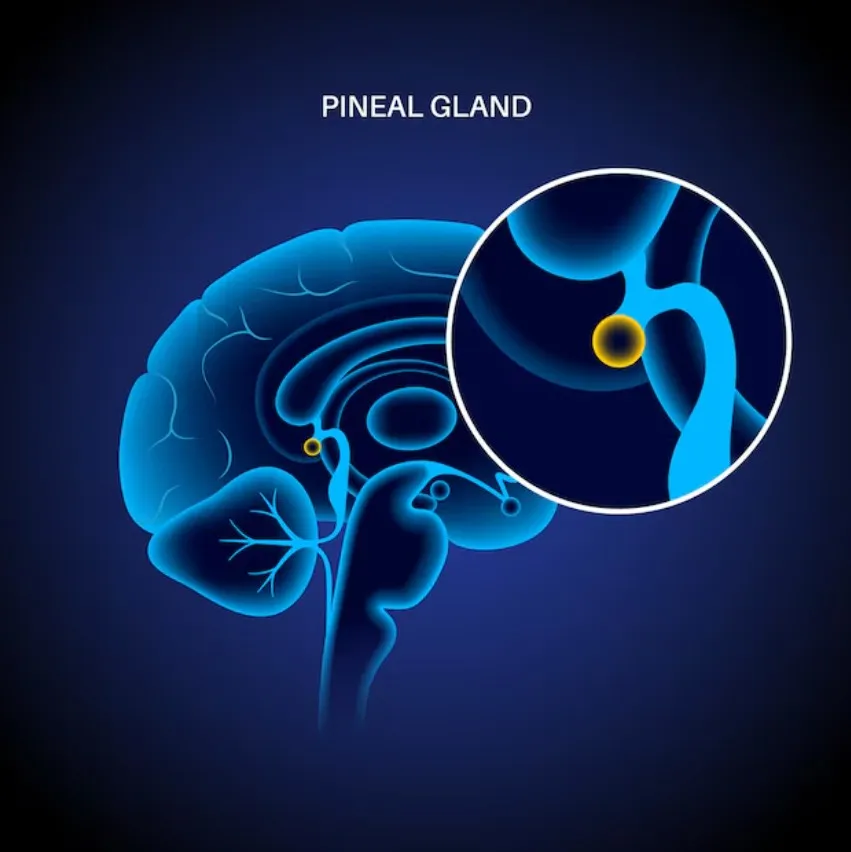
The Pineal Gland: The Single Eye
“The light of the body is the eye: if therefore thine eye be single, thy whole body shall be full of light.” — Matthew 6:22 (KJV)
Donahue argues the single eye isn’t metaphorical. It’s the pineal gland — the small endocrine gland at the center of the brain between the two hemispheres. The anatomical “third eye” referenced across Hindu, Buddhist, and Egyptian traditions.
The Genesis connection: in Genesis 32:30, Jacob wrestles with an angel (the internal struggle of meditation, subduing the ego mind) and names the place Peniel, declaring “I have seen God face to face.” Peniel. Pineal. The phonetic overlap, on Donahue’s reading, is the scriptural writers encoding the location where divine encounter occurs — inside the brain, at the pineal gland.
Donahue’s core formula: God is light. Light is photons. The pineal gland is the brain’s primary photosensitive structure — a literal light receptor. If God is light, and the pineal gland receives light, then the pineal gland is the organ of divine reception. When scripture says to see God face to face, it means to activate the pineal through meditation and receive the light directly.
Meditation as the Central Instruction
Meditation isn’t an Eastern import grafted onto Christian scripture. It’s the central instruction of the Bible, hidden behind allegory.
“Be still, and know that I am God” (Psalm 46:10) is a meditation directive. Still the mind; in the stillness, consciousness reveals itself. Not through thinking harder, but through ceasing to think at all. The Battle of Jericho — Joshua marching seven times around the city, then shouting, the walls falling — describes the meditative ascent of energy through the seven nerve centers, reaching the pineal at the seventh, the wall separating the meditator from right-hemispheric awareness collapsing. David and Goliath: the child (inner divine consciousness) defeats the giant (the lower mind) by selecting five smooth stones — control over the five senses. The Exodus from Egypt is the soul’s liberation from the dominance of the left hemisphere through meditative practice. Casting nets to the right side of the boat (John 21:6) is the explicit instruction to shift awareness to the right hemisphere, where abundance awaits.
The mechanism is consistent with the rest of the framework. Meditation quiets the left hemisphere. As left-hemisphere chatter subsides, right-hemisphere awareness emerges. The pineal gland — freed from the noise of the analytical mind — becomes receptive to coherent light, which is bio-photons in Fritz-Albert Popp’s research. The kingdom of heaven is accessed not through belief in a creed but through the physiological act of quieting the mind and activating the brain’s latent capacities.
Where Donahue Earns His Place
Donahue’s work isn’t airtight. Individual claims range from well-supported (the existence of Crux, the pineal gland’s photosensitivity, the archaeological challenges to the Exodus narrative) to speculative (the specific tribe-to-cranial-nerve mapping, the confident etymology of Peniel as pineal) to frankly unverifiable nonsense. The correct posture toward his corpus is the same one he urged toward scripture: take nothing literally, subject everything to inquiry, keep what aligns with direct experience and the rest of what you know, and leave the rest.
Within this framework specifically, Donahue earns his place for a narrower and more precise reason. He’s the only teacher in the lineage who insists the inner work is also a physical event. Neville tells you the kingdom of heaven is within you and means it psychologically. Donahue tells you the kingdom of heaven is within you and means it anatomically — a specific region of the brain, activated by a specific physiological process, with scripture as the operating manual. Whether or not every detail of his decoding is correct, that framing is the bridge between the purely psychological reading (Neville, Watts) and the neuroscientific reading (McGilchrist, Taylor, Popp). Without Donahue, the framework has a theology and a neuroscience but no scripture linking them. With him, the Bible becomes the third witness — saying the same thing the other two say, in its own older, stranger language.
4. God Is Light: The Biophoton Layer
Donahue’s central claim is that God is light (1 John 1:5), light is photons, and the pineal gland is the brain’s photosensitive receptor — therefore the pineal is the organ of divine reception. Pulled apart and read as physics rather than metaphor, the claim is more defensible than it looks. The peer-reviewed literature on biophotons supplies most of what would be required to take it seriously. For the longer case that quantum mechanics and scripture describe the same operation in two vocabularies, see God Is Light.
What Biophotons Are
Your body emits light. Literally, measurably, in the ultraviolet-to-visible spectrum. These emissions are called biophotons, or in the technical literature, ultra-weak photon emissions (UPE). They were first observed by the Russian biologist Alexander Gurwitsch in the 1920s, and the field was rebuilt and extended by the German biophysicist Fritz-Albert Popp from the 1970s until his death in 2018.
The basic science is established. Living cells produce photons as a byproduct of oxidative metabolic processes, particularly in the mitochondria and around the DNA. The emission rate is low — single photons per square centimeter per second — but it is measurable with sensitive photomultiplier equipment, and the pattern is consistent across all living systems. Plants emit. Animals emit. Bacteria emit. You emit, right now, while you are reading this.
The numbers that matter: healthy cells emit coherent, organized light. Stressed or diseased cells emit disorganized, elevated emissions. The “glow” of health, in other words, isn’t entirely metaphorical. Biophoton emission spikes dramatically near death and under extreme biological stress. The human brain produces orders of magnitude more biophotons than any other known biological system, and biophoton emission has been detected in brain tissues — rat hippocampal slices, cerebellar neurons — in patterns that correlate with neural-metabolic activity. There is a small but serious literature arguing that photonic signaling may represent an additional mechanism for neural information processing alongside the electrical and chemical channels.
Popp’s Coherence Claim
Popp’s signature contribution, and the part of the literature where he extended past the consensus, is the claim that biophotons are not random metabolic noise. He argued they exhibit quantum coherence — meaning the photons are synchronized in phase, capable of carrying information, and behave less like a thermal byproduct and more like the output of a tuned biological laser. His experimental work suggested DNA may serve as both the source and storage medium for these emissions, with light stored in the helix and released over time.
The coherence claim is real, and it is contested. Popp’s experimental data has been partially replicated; his theoretical interpretation is still debated. The honest position is that biophoton emission is established science, the coherence claim is at the frontier of the field, and the popular extensions of Popp’s work into wholesale claims about cellular communication and consciousness are operating ahead of the peer-reviewed evidence. Treat it the way Donahue’s etymologies should be treated: directionally suggestive, operationally usable, philologically not airtight.
The Pineal as Photosensitive Receptor
The link to Donahue’s claim runs through the pineal gland’s actual neuroanatomy. The pineal is genuinely photosensitive. In birds, reptiles, and amphibians, it is a literal third-eye organ — light passes through the thin cranial bone above it and the gland itself responds. In mammals, the photosensitivity is mediated indirectly through the retina and the suprachiasmatic nucleus, but the gland’s function as the body’s primary photoperiodic regulator — the structure that converts light information into hormonal signaling, principally melatonin — is established.
The eyes are the window to the soul.
The light in your eyes.
In other words: the gland Donahue identifies as the single eye of Matthew 6:22 is, in fact, the brain’s primary light-responsive structure. The phonetic overlap of Peniel and pineal may be coincidence; the functional identification of the gland as a light receptor is not. For the deep dive on what five separate civilizations independently pointed at, see The Pineal Gland: Seat of the Soul.
If the brain produces coherent light, and the pineal gland is photosensitive, and meditation quiets the metabolic noise of the left hemisphere — the claim here is that the gland becomes available, in a literal physiological sense, to receive the coherent endogenous emission. This is what Donahue means when he says scripture is an instruction manual for activating the pineal. The mechanism isn’t supernatural. It’s the brain’s own light, finally arriving at its own receptor, once the noise that masked it has been turned down.
The Scriptural Inventory
Once the physics is on the table, the recurring scriptural language about light reads less like devotional poetry and more like description.
“God is light, and in him is no darkness at all.” — 1 John 1:5
“And God said, Let there be light: and there was light.” — Genesis 1:3
“Ye are all the children of light, and the children of the day.” — 1 Thessalonians 5:5
“The light of the body is the eye: if therefore thine eye be single, thy whole body shall be full of light.” — Matthew 6:22
“In him was life; and the life was the light of men.” — John 1:4
“I am the light of the world.” — John 8:12
If God is light, and you produce light, and that light is coherent and capable of carrying information, and the pineal gland is the brain’s photosensitive structure — the theological language stops being metaphor and starts being description. The scriptures aren’t telling you what God is like. They are telling you, in the available vocabulary of three thousand years ago, what is happening inside you.
The wager here is that this is the layer where Donahue’s neuroanatomical reading and the peer-reviewed biophoton research and the contemplative traditions’ light language all converge. Not coincidentally. Mechanically.
5. The Twelve Stations: Inside the Skull
The synthesis above is most useful when reduced to a specific operational sequence. Here is what the framework actually claims is happening inside the skull when the meditation works — twelve stations, drawn from Donahue and the broader esoteric tradition, mapping the rise of the conserved seed from the base of the spine to its arrival at the pineal gland.
This is the crucifixion. Not in Judea. Between your ears.
| # | Station | Anatomy | Scripture |
|---|---|---|---|
| I | The Seed in the Loins | Testes / sacrum / first chakra | ”Put, I pray thee, thy hand under my thigh.” (Gen 24:2) |
| II | Celibacy — Seed Retention | Sacral chakra held closed | ”Onan… spilled it on the ground… and the thing which he did displeased the Lord.” (Gen 38:9–10) |
| III | Meditation Begins | Left hemisphere quiets | ”Be still, and know that I am God.” (Ps 46:10) |
| IV | The Seed Rises | Seven chakras / Jacob’s Ladder | ”He dreamed, and behold a ladder set up on the earth, and the top of it reached to heaven.” (Gen 28:12) |
| V | Crosses the Brainstem | Olivary bodies (medulla) | “His feet shall stand upon the Mount of Olives.” (Zech 14:4) |
| VI | Enters the Hippocampus | Ammon’s Horn | ”These things saith the Amen…” (Rev 3:14) |
| VII | Entombment in the Fornix | Fornix — Lat. fornix, vault, arch | ”He laid it in a sepulchre that was hewn in stone.” (Lk 23:53) |
| VIII | Three Days in the Tomb | Dormancy / quiescence | ”As Jonah was three days in the whale’s belly…” (Mt 12:40) |
| IX | The Stone Rolled Away | Foramen of Monro opens — “For-Amen" | "The stone was rolled away from the door.” (Mk 16:4) |
| X | Light Enters the Inner Sanctum | Third ventricle — Holy of Holies | ”Between the wings of the Cherubim.” (Ex 25:22) |
| XI | Pineal Gland Activates | Single Eye / Peniel | ”If thine eye be single, thy whole body shall be full of light.” (Mt 6:22) |
| XII | Resurrection | Right hemisphere assumes mastery | ”I am the resurrection, and the life.” (Jn 11:25) |
Read as a single arc, the twelve stations describe four dramatic beats.
Act I — The Seed. The substance that will rise must first be conserved. Testes, testify, testament — the patriarchs swore on the seat of generative power because the seed is the source. Spent outward, it makes flesh. Held inward, it makes light. This is what celibate traditions across cultures have been pointing at, often badly explained. The seed conserved at the base is the substance that arrives at the crown.
Act II — The Burial. The risen current enters the fornix and is sealed. The Latin fornix means vault or arch — and the fiber bundle of that name, arched between the hemispheres, is the structure where the rising substance is anatomically held. The arch becomes the tomb. The conscious mind perceives nothing happening.
Act III — The Three Days. Quiescence. The solstice pause. Persistence in the assumed state without grasping at result. The seed underground. This is the Sabbath principle from earlier in the framework rendered in physiological terms: after the seed is planted, the correct posture is rest-as-completion, not anxious checking. Dig up the seed and the gestation aborts.
Act IV — The Opening. The Foramen of Monro — the For-Amen, the opening behind the anterior pillars of the fornix — yields. Light passes through to the third ventricle. The pineal ignites. Cerebrum (Cherubim) covers the inner sanctum. New consciousness wakes.
The convergence with Neville is exact. Neville said the crucifixion is the death of the old state and the resurrection is the birth of the new assumption hardened into fact. Donahue says it happens physically in the brain through meditation. They’re describing the same event — Neville from the psychological plane, Donahue from the neuroanatomical plane.
A Word on the Etymologies
Some of Donahue’s etymological pivots vary in defensibility. Testes / testify / testament genuinely share the Latin root testis (witness), and Genesis 24:2 is genuinely an oath sworn on the generative organ — that survives scrutiny. Foramen → For-Amen, Cerebrum → Cherubim, and Fornix → tomb are cross-language puns, not academic philology. The neuroanatomy is real. The Latin-to-Hebrew bridges are interpretive.
The frame’s value is operational, not philological. Treat it as a meditation map, not a doctoral thesis.
What This Is Actually For
Strip away the symbolic apparatus and the operating instruction at the bottom of all this is straightforward.
Quiet the left hemisphere. Conserve the energy that would otherwise be spent outward in compulsive narration, anxiety, and grasping. Let it rise. Hold the assumed state through the period of apparent stasis when nothing seems to be happening. Stay out of the way. The opening, when it comes, isn’t something you do. It’s something that happens once you’ve stopped doing.
The claim here is that this process is what every contemplative tradition has been pointing at — from Neville’s psychology to Donahue’s neuroanatomy, from McGilchrist’s master/emissary thesis to Taylor’s stroke account to Popp’s bio-photon research to the Stoics’ inner citadel to Wu Wei. The vocabularies are different. The operation is the same.
The crucifixion is the death of the old state. The resurrection is the activation of right-hemispheric awareness once the ego-mind has been silenced. Both events occur, on this reading, in the place between your ears that the Greek text of Matthew 27:33 calls Golgotha — the place of the skull.
Take it literally enough to run it. Hold the rest lightly.
Sources
Primary:
- Neville Goddard, Feeling is the Secret (1944), The Power of Awareness (1952), Awakened Imagination (1954)
- Bill Donahue, Hidden Meanings lectures (hiddenmeanings.com); YouTube channel bdona4556
- Iain McGilchrist, The Master and His Emissary (2009), The Matter with Things (2021)
- Jill Bolte Taylor, My Stroke of Insight (2008), Whole Brain Living (2021)
- Alan Watts, The Book: On the Taboo Against Knowing Who You Are (1966)
Supporting:
- Fritz-Albert Popp, Biophoton Coherence Research — peer-reviewed publications and Integrative Biophysics (Popp & Beloussov, eds., 2003)
- Alexander Gurwitsch, Mitogenetic Radiation (1923) — the original observation of biophoton emission
- Ze’ev Herzog, Haaretz archaeological essays (1999)
- The Kybalion — Three Initiates (Hermetic principles)
- Christopher Langan, The Cognitive-Theoretic Model of the Universe
- Vadim Zeland, Reality Transurfing: Steps I–V
Scripture (KJV): Genesis 1:3; 24:2; 28:12; 32:30; 38:9–10. Exodus 3:14; 25:22. Psalm 46:10. Zechariah 14:4. Matthew 6:22; 6:34; 12:40; 13:34; 27:33. Mark 14:58; 16:4. Luke 1:38; 17:21; 23:53. John 1:4; 8:12; 10:30; 11:25; 21:6. 1 Thessalonians 5:5. 2 Corinthians 3:6. Revelation 3:14. 1 John 1:5.
Caveats stand. This is a working synthesis, not received doctrine. Take nothing literally, subject everything to inquiry, keep what aligns with direct experience, and discard the rest.