The Convergence: Why the Traditions Agree
Ignore the vocabulary, eight contemplative and scientific traditions describe the same operation. Read them as eight rotations of the same diagram.

“As above, so below; as below, so above.” — The Kybalion
Read enough contemplative literature for any length of time and you start to notice a pattern. You’re halfway through a Stoic letter, or a verse of the Tao Te Ching, or a Neville Goddard lecture, or a chapter of McGilchrist, and you stop. The writer is describing — in different words, with different metaphors, from inside a completely different cultural and historical position — the SAME EXACT operation you read about yesterday in a tradition with no institutional connection to this one.
It isn’t a stylistic resemblance. It’s structural identity. And once you’ve noticed it once, you start noticing it everywhere. Pattern recognition at its finest.
My foundational claim here follows from this observation: at a minimum eight distinct contemplative schools of thought are pointing at the same operation under different vocabularies, and the converging description is precise enough to be reverse-engineered into an operating manual for life. The traditions aren’t borrowing from each other. Most of them developed in isolation. The convergence is the kind of agreement you get when independent observers describe the same physical fact from different angles.
If eight traditions describe the same operation in eight vocabularies, the operation is probably real and probably worth running. That’s the bet of a lifetime.
The Single Claim Beneath The Translations
Stripped of vocabulary, the shared claim runs like this:
There is a deeper layer of consciousness that operates by reception, presence, and assumption — call it the receptive mode (the right) — and a surface layer that operates by analysis, comparison, and grasping — call it the executive mode (the left).
The healthy condition is the receptive layer leading and the executive layer serving (counterintuitive no?). Practical liberation, in any of its names, consists in restoring the proper order: dropping the grasping of the executive mode, reentering the receptive layer, and operating from it with the executive mode reduced to its proper subordinate role.
That single description is what the eight traditions below restate in eight ways. Read them as eight rotations of the same diagram.
1. Neville Goddard — The Law of Assumption
Neville (1905-1972) called consciousness the only reality and assumption its operative principle. The instruction: assume the feeling of the wish fulfilled. Occupy, today, the inner state of the version of you who has already arrived at the desired outcome. Assumption is cause; manifestation is effect. Grasping by the executive mind — anxiety, comparison, demand for proof — aborts the assumption. The receptive state, sustained, hardens into fact. “An assumption, though false, if persisted in will harden into fact” (The Power of Awareness, 1952).
The vocabulary is planted seed and Sabbath: assume the state, sleep in it, let it gestate, refuse to dig it up to inspect.
2. Iain McGilchrist — The Master and His Emissary
McGilchrist’s argument: the right hemisphere of the brain is built to be the Master — holistic, present, contextual, attentive to the whole. The left hemisphere is built to be the Emissary — focused, analytical, sequential, useful for the particular task. The healthy condition is right leading and left serving. The pathology, which McGilchrist argues is modernity’s signature condition, is the Emissary having usurped the Master.
This is the same diagram in neuroanatomy. The receptive mode is the right hemisphere. The grasping mode is the unsupervised left. The instruction is the same instruction Neville is giving in a different vocabulary.
3. Alan Watts — Hide and Seek
Watts described the human situation as a cosmic game in which the underlying consciousness — the deep-down basic whatever there is — is playing at being temporarily not-itself in order to experience itself afresh. “You’re all that, only you’re pretending you’re not.”
The grasping at outcomes, the desperate striving for what you already are, is what Watts called the backwards law: the harder you try to get something, the more you confirm to yourself that you don’t have it. The release is to recognize the game, drop the pretense of separateness, and stop chasing what was never absent.
Same diagram, metaphysics foregrounded. Grasping is the player who has forgotten the game. Reception is the player who remembers.
4. Vadim Zeland — Reality Transurfing
Zeland’s vocabulary is the most secular of the set and probably the most operationally precise on one specific failure mode. He calls it excess potential — the energy charge that builds up around an outcome when the outcome has been assigned too much importance. The universe, in his cosmology, contains balancing forces that automatically push back against any concentration of excess potential, which is why the things you most desperately want tend, statistically, to be the things that elude you.
The corrective: hold the direction (keep wanting the outcome) while dropping the importance. Caring as direction, not caring as weight.
5. Bill Donahue — The Bible as Neuroanatomy
Donahue (1936-2020) read the Bible as a coded instruction manual for the human brain. The temple is the skull. The Holy of Holies is the inner sanctum protected by the meninges. The pineal gland is the single eye of Matthew 6:22. Meditation is the central biblical instruction, encoded as Joshua marching seven times around Jericho, David selecting five smooth stones to control the five senses, the exodus from Egypt as the soul’s liberation from the lower mind. The crucifixion takes place at Golgotha — “the place of the skull” — that is, inside your head. The resurrection is the activation of right-hemispheric awareness once the executive mind has been silenced.
Same diagram in scriptural code. Grasping is the carnal mind. Reception is Christ consciousness in the right hemisphere. For the longer case that scripture is itself a coded manual for the nervous system, see The Real Bible. For the single structure all five contemplative traditions independently point at, see The Pineal Gland: Seat of the Soul.
6. Stoicism — The Inner Citadel
The Stoic formulation is the most matter-of-fact. Marcus Aurelius, Epictetus, and Seneca describe a part of the self that doesn’t depend on external outcome and therefore can’t be destabilized by it: the inner citadel. The work is to identify what is and isn’t within your control, withdraw your investment from what isn’t, and operate from the citadel that remains untouched by external events.
Same diagram, ethical register. Grasping is investment in the uncontrollable. Reception is the citadel that remains untouched.
7. Taoism — Wu Wei
Wu Wei is usually translated as non-action, but more accurately renders as effortless action — action that doesn’t strain against the grain of things. Water is the metaphor: water doesn’t push; it descends, and in descending, it carves canyons. The skilled actor in any domain — the master craftsman, the dancer, the trader at his cleanest, the parent in flow — is operating from wu wei. The Tao Te Ching’s instruction is to align with the way things move rather than force them into a pattern your executive mind has decided.
Same diagram, motion register. Grasping is the strain against. Reception is alignment with.
8. Kabbalah — The Three Pillars
Kabbalah maps consciousness onto a three-pillar architecture: the right pillar of Mercy (Chesed), the left pillar of Severity (Gevurah), and the central pillar of Balance which resolves the tension between them. Healthy = the central pillar carrying the operational authority. Pathology = the left pillar (judgment without mercy, analysis without context, the Sitra Achra or “Other Side”) operating unmitigated.
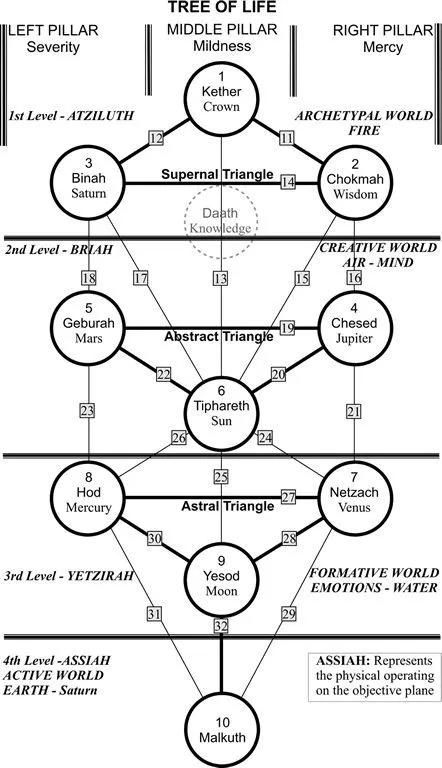
The Kabbalistic instruction is bittul: self-nullification, the dropping of the small ego, opening the channel through which the Ein Sof — the infinite — can express itself through this particular configuration of body and mind.
Same diagram, cosmogonic register. Grasping is unbalanced Gevurah. Reception is the central pillar in proper relation to both sides.
Reading The Diagram
Eight traditions. Eight vocabularies. One diagram.
| Tradition | Receptive Mode | Grasping Mode | Operative Instruction |
|---|---|---|---|
| Neville | The assumed state | Anxious demand for proof | Enter the assumed state. |
| McGilchrist | Right-hemispheric Master | The unsupervised Emissary | Subordinate the analytical voice. |
| Watts | The player who remembers | The player who forgot | Stop chasing what you already are. |
| Zeland | Direction without weight | Excess potential | Hold the want. Drop the importance. |
| Donahue | Christ consciousness | The carnal mind | Be still. Let the inner light rise. |
| Stoicism | The inner citadel | Investment in the uncontrollable | Withdraw investment from what isn’t yours. |
| Taoism | Wu Wei (alignment with) | Strain against | Stop pushing. Move with the current. |
| Kabbalah | The central pillar | Unbalanced Gevurah | Drop the small self. |
In every case, the grasping mode is the executive mind operating without its proper subordination. In every case, the receptive mode is the deeper layer reasserting authority. The reason this matters isn’t academic. If the same operation has been independently described by Stoics, Taoists, Kabbalists, Christian mystics, mid-century manifestation teachers, and contemporary neuroscientists, it’s unlikely to be an artifact of any one tradition’s metaphor. More likely, it’s a real feature of how consciousness functions — observed, named, and described by everyone who looked carefully enough, in whatever vocabulary their culture provided.
This is why you see successful practitioners from all walks of life.
The convergence breeds options. You don’t have to choose between Neville and McGilchrist, between the Stoics and the Taoists, between Donahue and Zeland. They aren’t competing accounts. They’re rotations of the same fact, and the practitioner who can hold multiple rotations simultaneously has more handles on the operation than the practitioner restricted to one. The same move, run between just two of the closest traditions and taken all the way down to the verse, is Krishna and Christ.
The Working Use
The eight vocabularies aren’t interchangeable in their utility. Each one is sharpest for a specific failure mode.
| When you… | Reach for | Because |
|---|---|---|
| Are grasping at outcome | Zeland | Excess potential is the cleanest diagnosis. |
| Can’t subordinate the analytical voice | McGilchrist | Master/Emissary is the clearest frame. |
| Have inflated importance around external events | Stoics | The inner citadel cuts cleanly. |
| Forget the desired state is already available | Watts | Cosmic hide-and-seek is the corrective. |
| Need to protect an assumption across the lag | Neville | He wrote the operating manual. |
| Need to enlist the body | Donahue | Neuroanatomy and the fasting traditions are the operational layer. |
| Want the deepest theological vocabulary | Kabbalah | The three pillars and Ein Sof are available. |
| Are asking how to act from the state | Taoism | Wu Wei is the instruction. |
Eight tools. One toolbox. The convergence is what licenses keeping all eight.
Pick the vocabulary that fits the moment. They all open the same door.

Sources
Primary across the eight traditions:
- Neville Goddard, Feeling is the Secret (1944), The Power of Awareness (1952)
- Iain McGilchrist, The Master and His Emissary (2009), The Matter with Things (2021)
- Alan Watts, The Book: On the Taboo Against Knowing Who You Are (1966)
- Vadim Zeland, Reality Transurfing: Steps I–V
- Bill Donahue, Hidden Meanings lectures (hiddenmeanings.com)
- Marcus Aurelius, Meditations (Gregory Hays translation)
- Tao Te Ching (Stephen Mitchell translation recommended)
- The Zohar; Daniel Matt, The Essential Kabbalah
Supporting:
- The Kybalion — Three Initiates (Hermetic principles)
- Jill Bolte Taylor, My Stroke of Insight (2008)
- Mihaly Csikszentmihalyi, Flow (1990)
Caveats stand. The convergence is a working synthesis, not a doctrinal claim. None of the eight traditions, taken on its own terms, would describe itself as identical to the others. The move here is to hold the structural identity while honoring the surface differences. Take nothing literally, subject everything to inquiry, keep what aligns with direct experience.